Deye Inverter Grid Faults: AC Undervoltage (F42) and Frequency Errors (F47, F48)
Updated 7 September 2026 · By SolarNevs Research Desk, Dealer surveys + verified sources · 3 sources · Method ↗
Key Takeaways
- Deye inverters report grid faults like F42 (AC line low voltage), F47 (AC over frequency), and F48 (AC lower frequency) when the utility grid is unstable.
- The first step is always to check all AC connections for tightness and correctness.
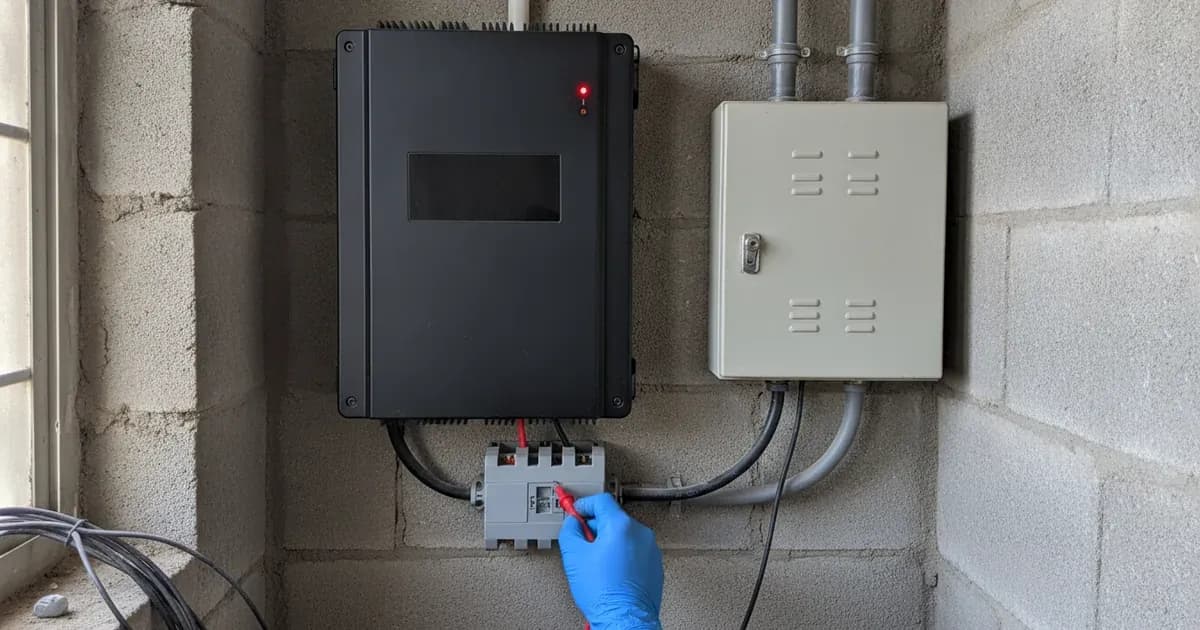
- Verify the actual grid voltage and frequency using a multimeter to compare against the inverter's specifications.
- Never attempt to open the inverter or work on live AC circuits without proper training and safety equipment.
- If basic checks do not resolve the issue, contact a qualified solar technician or Deye support.
What to do when your Deye inverter reports a grid fault like F42, F47, or F48?
Deye inverters display grid fault codes such as F42 (AC line low voltage), F47 (AC over frequency), and F48 (AC lower frequency) when the incoming utility grid's voltage or frequency falls outside the inverter's acceptable operating parameters. The most common causes are unstable grid conditions or issues with the AC wiring connecting the inverter to the grid. Your first step should be to inspect all AC connections and confirm the grid supply is stable.
Diagnosis
Follow these steps to diagnose and potentially resolve Deye inverter grid faults.
- Check for other grid-related faults.
- Observation: The inverter displays F35.
- Meaning: F35 indicates "No AC grid" or "No Utility". This means the inverter is not detecting any grid connection.
- Action: Confirm the grid supply is active. Check the main breaker for your solar system and ensure any switches between the inverter and the grid are in the ON position. Inspect the grid connection cables for damage or disconnections.
- Inspect AC wiring connections.
- Observation: The inverter displays F42, F47, or F48.
- Meaning: These codes indicate AC line low voltage (F42), AC over frequency (F47), or AC lower frequency (F48). Loose or corroded AC connections can lead to voltage drops or unstable frequency readings at the inverter.
- Action: Safely disconnect all power to the inverter (AC and DC). Visually inspect all AC cables connected to the inverter and the main distribution board. Ensure they are firmly and correctly connected. Tighten any loose terminals.
- Measure grid voltage and frequency.
- Observation: AC connections appear sound, but the fault persists.
- Meaning: The grid itself may be unstable or outside the inverter's operational range.
- Action: With appropriate safety precautions, use a multimeter to measure the incoming AC voltage and frequency directly at the grid connection point where the inverter connects. Compare these readings to your local grid standards and the inverter's specifications (which are typically found in the Deye inverter manual, though specific ranges for Pakistan are not provided in the manual we checked).
- Restart the inverter.
- Observation: After checking connections and grid parameters, the fault remains.
- Meaning: A temporary glitch in the inverter's monitoring system might be causing the error.
- Action: Turn off the DC switch and the AC switch on the inverter. Wait for one minute. Then, turn on the DC switch first, followed by the AC switch. Observe if the fault clears.
Cause/fix table section
Symptom detail | Likely cause | Fix |
|---|---|---|
Inverter reports F42 | AC line low voltage / Grid voltage fault | Check the AC voltage is in the range of standard voltage in specification. Check whether grid AC cables are firmly and correctly connected. |
Inverter reports F47 | AC over frequency / Grid frequency out of range | Check the frequency is in the range of specification or not. Check whether AC cables are firmly and correctly connected. |
Inverter reports F48 | AC lower frequency / Grid frequency out of range | Check the frequency is in the range of specification or not. Check whether AC cables are firmly and correctly connected. |
Inverter reports F35 | No AC grid / No Utility | Confirm grid is lost or not. Check the grid connection is good or not. Check the switch between inverter and grid is on or not. |
Understanding Deye Inverter Grid Faults
Deye hybrid inverters are designed to operate within specific grid voltage and frequency parameters. When the utility grid deviates from these parameters, the inverter will disconnect from the grid to protect itself and the connected loads, displaying a fault code.
- F42 (AC line low voltage): This error means the incoming grid voltage has dropped below the inverter's minimum threshold. This can be due to a brownout, an overloaded grid, or poor connections.
- F47 (AC over frequency): This indicates the grid frequency has risen above the inverter's maximum allowed limit.
- F48 (AC lower frequency): This indicates the grid frequency has dropped below the inverter's minimum allowed limit.
While the provided Deye manuals (e.g., for SUN 3.6-6K SG03LP1-EU, SUN 7.6-8K SG01LP1-EU, SUN 3-6K SG04LP1-EU-SM2 models) list these fault codes and general solutions, they do not specify the exact voltage or frequency ranges for the Pakistani market. You may need to consult your local utility provider or a qualified technician to understand the standard grid parameters in your area.
For a broader understanding of inverter fault codes, you can refer to our guide on /pk/guides/fixes/solar-inverter-fault-codes-explained. If you are experiencing issues with battery communication, which can sometimes be mistaken for grid issues, our article on /pk/guides/fixes/troubleshooting-battery-communication-errors-in-solar-inverters might be helpful.
Safety: Working with AC Power
Working with AC power carries a significant risk of electrical shock and serious injury. Always prioritize safety when troubleshooting grid-related issues.
- Disconnect all power: Before attempting any inspection or maintenance, ensure all AC and DC power sources to the inverter are disconnected. This includes turning off grid breakers, generator breakers, and battery disconnects. The Deye manual states, "To reduce risk of electric shock, disconnect all wires before attempting any maintenance or cleaning. Turning off the unit will not reduce this risk."
- Qualified personnel: All wiring and electrical work must be performed by a professional person.
- Insulated tools: Use only insulated tools when working near electrical components.
- Grounding: Ensure the inverter is connected to a permanent grounded wiring system, complying with local requirements. The ground cable shall be connected to the ground plate on the grid side to prevent electric shock.
- Never short circuit: Never cause AC output and DC input to be short circuited. Do not connect to the mains when DC input short circuits.
When to call a technician instead
You should contact a qualified solar technician or Deye support if:
- The grid fault persists after you have performed all the basic checks (inspecting connections, restarting the inverter).
- You are unable to safely measure grid voltage and frequency.
- You suspect the issue is with the utility grid supply itself.
- The Deye inverter manual advises contacting support for the specific fault code. For F42, F47, and F48, the manual states, "Seek help from us, if can not go back to normal state."
- You are uncomfortable working with high voltage electricity.
If any fault messages appear and are not removed after restarting, contact your local dealer or service center. Be prepared to provide the inverter serial number, distributor information, on-grid power generation date, a detailed problem description (including the exact fault code and indicator status), and your contact information.
Still showing the fault? Book a technician
If the steps above did not clear it, tell us the inverter or battery and the exact code. We pass it to a technician who covers your city; visit charges are quoted before they come.
How this pays for the site: the technician or verifier pays SolarNevs a fixed introduction fee. Nobody pays to be recommended, and you are free to use our free guides instead.
Frequently asked questions
What does Deye inverter error F42 mean?
Deye inverter error F42 indicates an AC line low voltage or grid voltage fault. This means the grid voltage is outside the inverter's acceptable operating range.
How do I fix a Deye inverter F47 or F48 error?
Errors F47 (AC over frequency) and F48 (AC lower frequency) mean the grid frequency is out of range. Check the AC cables for firm and correct connections. Verify the grid frequency is within the inverter's specified limits.
Why is my Deye inverter showing a grid fault?
A Deye inverter shows a grid fault when the utility grid's voltage or frequency falls outside its operational parameters. Common causes include loose AC connections, an unstable grid supply, or incorrect wiring.
Can I fix Deye inverter grid faults myself?
Always disconnect all AC and DC power to the inverter and wait for capacitors to discharge before inspecting any connections to avoid electrical shock. Be aware that the inverter can contain high DC voltages (up to 500V from PV input) even after power disconnection. This work should ideally be performed by a qualified professional to ensure safety and maintain warranty validity. You can perform initial checks like verifying AC cable connections and confirming grid presence. However, if the fault persists after these basic steps, or if you suspect an issue with the grid supply itself, contact a qualified technician or your local utility.
What should I do if my Deye inverter reports 'No AC grid' (F35)?
If your Deye inverter reports F35, check if the grid is lost, confirm the grid connection is good, and ensure the switch between the inverter and grid is on. If the issue continues, seek professional help.
References
- Deye SUN 3.6-6K SG03LP1-EU Manual Ver2.2 — accessed 23 August 2026
- Deye SUN 7.6-8K SG01LP1-EU Manual — accessed 23 August 2026
- Deye SUN 3-6K SG04LP1-EU-SM2 Manual — accessed 23 August 2026
Related guides
More from inverter errors & fixes.