Victron SmartSolar MPPT Sizing and Cold Weather Voc Calculation Guide
Updated 8 September 2026 · By SolarNevs Research Desk, Dealer surveys + verified sources · 2 sources · Method ↗
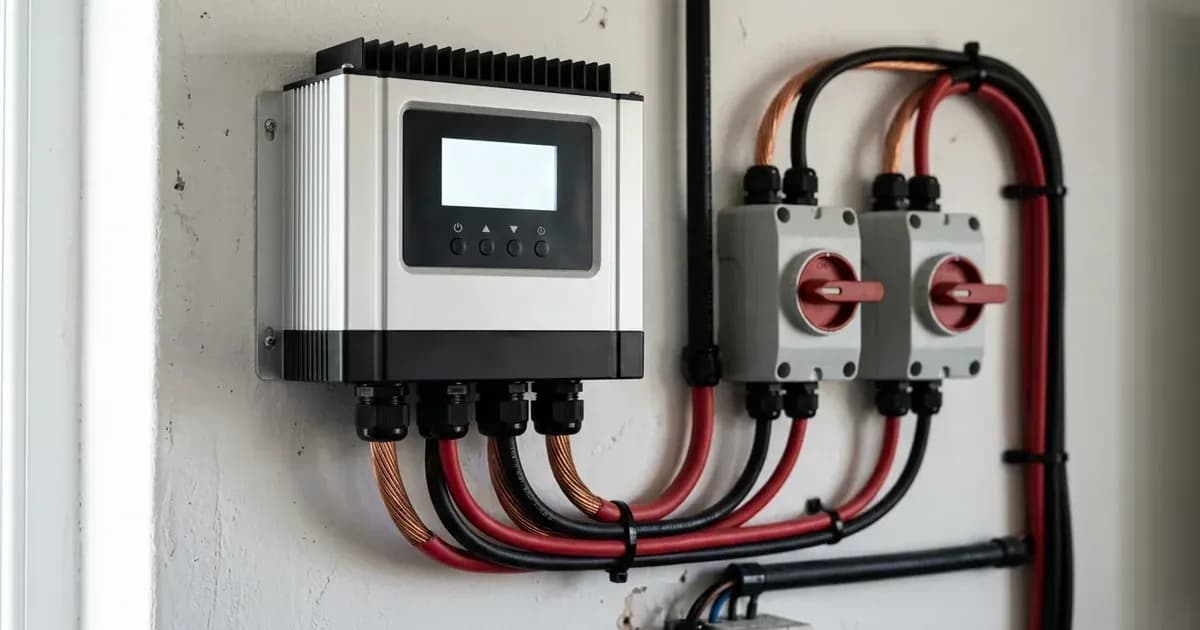
Properly sizing your solar array for a Victron SmartSolar MPPT charge controller is critical for system safety, efficiency, and longevity. This guide details the essential voltage limits, current considerations, and the crucial impact of temperature on your array's open-circuit voltage (Voc), particularly in cold climates.
Understanding MPPT Voltage Limits
The most critical parameter when designing a solar array for any MPPT charge controller is its absolute maximum PV open-circuit voltage (Voc). Exceeding this limit can cause permanent damage to the unit.
Absolute Maximum PV Voltage
Your solar array's open-circuit voltage must never exceed the maximum rated PV open circuit voltage (Voc) of the MPPT. The manufacturer explicitly states: "Never exceed the maximum rated PV open circuit voltage (Voc) of the MPPT; overvoltage permanently damages the charge controller." This is a non-negotiable limit.
The Impact of Temperature on PV Voltage
Solar panel voltage is not static; it changes with temperature. Specifically, "Solar panel open circuit voltage increases as ambient temperature drops, according to the panel temperature coefficient of Voc." This phenomenon is particularly important in cold environments, where Voc can rise significantly above the panel's nominal rating.
Cold Weather Voc Calculation
To prevent overvoltage, especially in winter, you must account for this temperature-induced voltage rise.
Calculating Maximum Array Voc
Before selecting your string length, you must "Calculate maximum array Voc at the local historical minimum temperature (e.g. -10°C)." This calculation requires knowing your specific solar panel's temperature coefficient for Voc, typically found in its datasheet. This coefficient, usually expressed in %/°C or V/°C, indicates how much the voltage changes per degree Celsius.
For example, when calculating open circuit voltage rise at -10°C, its Voc will increase. The calculation involves determining the voltage change based on the temperature difference and the coefficient, then adding this to the nominal Voc. Always use the coldest historical temperature for your location to ensure a sufficient safety margin.
Cold Climate Safety Margin
In extremely cold alpine climates, where temperatures can fall below -20°C, it is recommended to "design array series strings with an extra 10% safety margin below MPPT max voltage." This additional buffer helps mitigate the risk of unexpected voltage spikes or miscalculations in severe conditions.
MPPT Startup and Operational Voltage Requirements
Beyond the absolute maximum, Victron SmartSolar MPPTs have specific voltage requirements to begin and continue charging.
Minimum Start Voltage Difference
For the MPPT to initiate charging, "The MPPT requires PV voltage to exceed battery voltage by at least 5V (Vbat + 5V) to initiate charging." If your array's voltage is too close to the battery voltage, the controller will not start.
Operational Running Voltage
Once charging has commenced, the MPPT can continue to operate with a smaller voltage differential. "Once charging commences, the MPPT continues operating until PV voltage falls below battery voltage plus 1V (Vbat + 1V)." This allows the controller to maximize energy harvest even as PV voltage fluctuates, for example, due to cloud cover.
Maximum Short-Circuit Current (Isc) Considerations
While voltage limits are paramount, the array's short-circuit current (Isc) is also a critical factor.
Preventing Internal Hardware Damage
"PV array total short-circuit current must not exceed the controller maximum rated Isc to avoid internal hardware damage." Ensure the sum of the Isc from all parallel strings does not exceed the MPPT's specified maximum input current. SmartSolar controllers do offer a degree of protection: "SmartSolar controllers automatically throttle excess array power to their rated output charging current without overheating." However, this does not negate the need to respect the maximum input Isc rating.
Array Sizing Tools and Best Practices
Victron Energy provides resources to assist with correct sizing.
Official Sizing Calculator
"Use the official Victron MPPT Excel or web sizing calculator to verify module string voltage across expected temperature extremes." This tool helps confirm your calculations and ensures compatibility.
PV Array Isolation Testing
Before connecting your array to the MPPT, perform an insulation test. "Measure DC insulation resistance between PV positive/negative conductors and ground before connecting to MPPT terminals." This verifies the integrity of your array's wiring and prevents potential ground faults.
Safe DC Disconnect Practice
Always prioritize safety when working with your solar array. "Always open the DC PV array circuit breaker before disconnecting solar cables from the MPPT screw terminals." This ensures the array is de-energized, preventing arcs and potential injury.
Monitoring and Universal Application
Victron SmartSolar MPPTs offer integrated monitoring capabilities and are designed for broad application.
Integrated Bluetooth Monitoring
"Real-time PV voltage, current, and historical 30-day yield trends are monitored wirelessly via the VictronConnect mobile app." This feature allows for easy system performance tracking and troubleshooting.
Universal Multi-Market Scope
The principles and specifications discussed apply broadly: "Applies across all residential, marine, automotive, and commercial off-grid and grid-tied solar installations globally." This ensures consistency in design and installation practices worldwide.
```
Get three dated installer quotes for this system
Tell us your city and your summer electricity bill. We pass your number to up to three vetted installers who quote against the surveyed prices on this page, so nobody can quote you Rs 5 a watt over market.
How this pays for the site: installers pay SolarNevs a fixed introduction fee when we pass them a genuine enquiry. They cannot pay to appear higher, and our surveyed prices are published before any introduction. You can also take our dated price tables straight to any installer.
Frequently asked questions
What are the critical configuration rules for victron mppt solar sizing and temperature coefficients guide?
Verify system electrical ratings and program all limits accurately using VEConfigure3 or the VictronConnect mobile application.
How do safety isolation procedures work?
Isolate all AC and DC supplies and wait at least 10 minutes for internal capacitors to discharge safely before servicing connections.
References
- Victron SmartSolar MPPT Sizing and Temperature Coefficient Guide — accessed 27 August 2026
- VictronConnect MPPT Configuration and Historical Logging — accessed 27 August 2026
Related guides
More from sizing, net billing & installation.